Imagine standing in front of a painting worth more than a fleet of private jets, a skyscraper or one of the world’s most spectacular luxury estates. At the very top of the art market, a canvas is no longer valued only for the paint on its surface. It can become a piece of cultural history, a symbol of an artistic revolution and an object so rare that billionaires, museums and governments compete for the chance to own it.
The world’s most expensive paintings come from very different eras. Leonardo da Vinci represents the mystery and rarity of the Renaissance. Rembrandt stands at the height of the Dutch Golden Age. Paul Cézanne and Paul Gauguin helped change the direction of modern painting, while Willem de Kooning, Jackson Pollock, Mark Rothko and Andy Warhol transformed the art world in the 20th century.
And the prices can be extraordinary. One painting has crossed $450 million, while several others have changed hands for around $200 million or more. In many cases, the real drivers are not simply beauty or size, but scarcity, provenance, historical importance, museum-level recognition and the intense competition that appears when a masterpiece reaches the market.
There is one important point before looking at the ranking. This list uses the original sale or purchase prices rather than inflation-adjusted values. Public-auction figures are documented prices including fees where reported, while some private-sale figures are widely reported estimates because the full terms were never publicly disclosed. Currency-based purchases are shown in approximate US-dollar values at the time of the transaction.
1. Salvator Mundi by Leonardo da Vinci – $450.3 Million
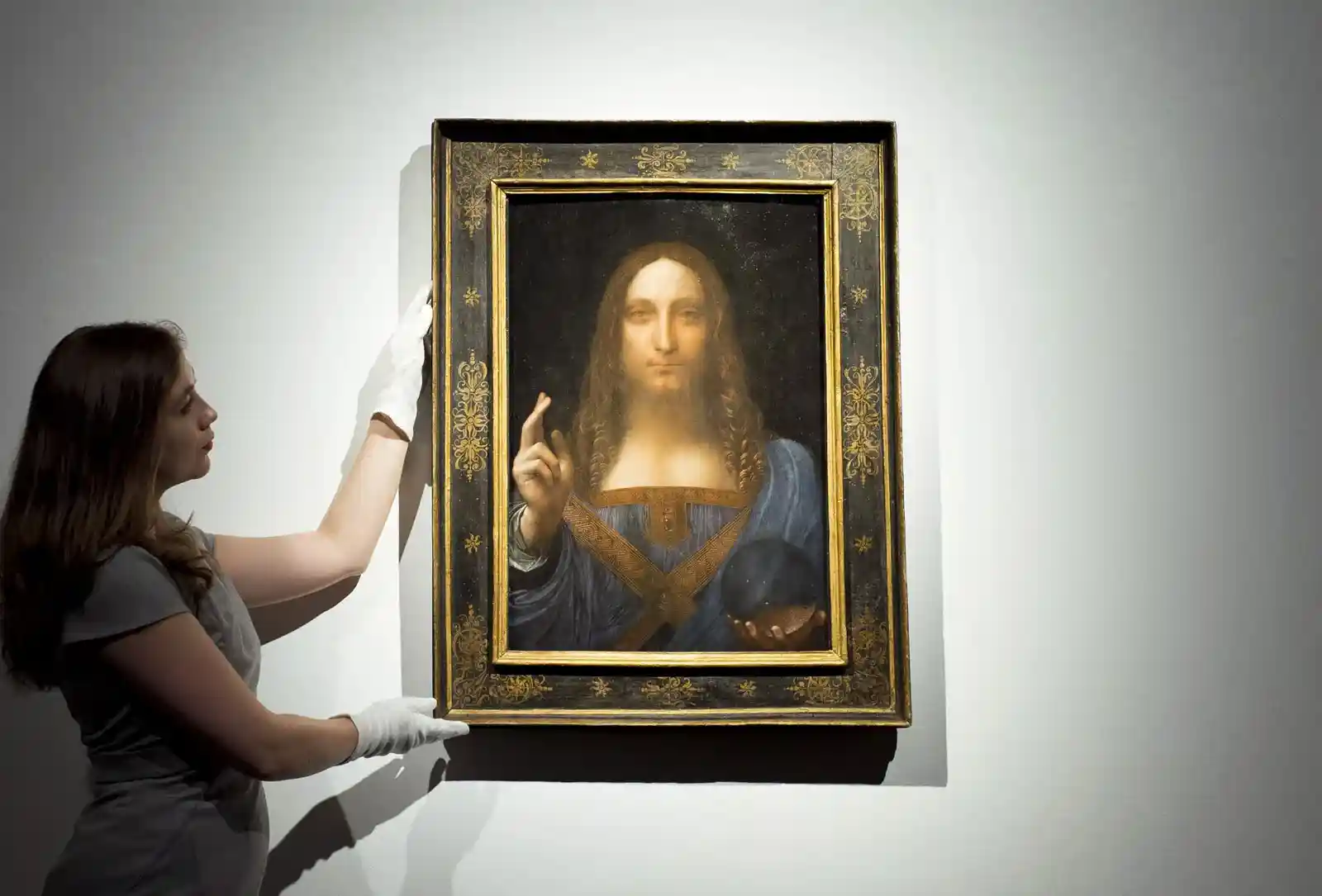
Salvator Mundi sits in a category of its own. The painting, depicting Christ as “Saviour of the World,” sold at Christie’s New York in November 2017 for $450,312,500, making it the most expensive painting ever sold at public auction.
Painted around 1500 and presented at the sale as a work by Leonardo da Vinci, the picture shows Christ raising one hand in blessing while holding a transparent orb in the other. Its value was magnified by the extreme rarity of surviving paintings associated with Leonardo: only a small number of works are generally accepted as being substantially from his hand, and almost all are held by museums.
The painting also carries a remarkable modern history. It had once been treated as a copy and sold for a tiny fraction of its later value before restoration, research and reattribution returned it to global attention. Some scholars have continued to debate the extent of Leonardo’s authorship, but the combination of rarity, mystery, provenance and the Leonardo name created an auction event unlike anything the art market had seen before.
2. Interchange by Willem de Kooning – Around $300 Million
Willem de Kooning’s Interchange shows how a radical abstract painting can become one of the most valuable objects in the world. The 1955 work was reportedly sold privately by the David Geffen Foundation to billionaire collector Kenneth C. Griffin in 2015 for around $300 million.
De Kooning was one of the central figures of Abstract Expressionism, the movement that helped shift the centre of the post-war art world toward New York. Interchange belongs to the period when he was moving away from his famous Woman paintings and pushing figure, landscape and abstraction into a more fluid visual language.
The price is even more striking when placed against its earlier market history. The work was originally sold in 1955 for about $4,000 and later achieved more than $20 million at auction in 1989. By 2015, its museum-level importance, scarcity and position within de Kooning’s career had pushed its reported value to an entirely different level.
3. The Card Players by Paul Cézanne – More Than $250 Million
Paul Cézanne’s The Card Players is one of the defining images of Post-Impressionism. One version from the celebrated series was sold privately in 2011 to Qatar for more than $250 million, a price that at the time was widely regarded as a new record for a painting.
Cézanne created several versions of card-playing Provençal men during the early 1890s. The paintings are quiet rather than theatrical: the figures sit absorbed in the game, reduced to solid shapes, carefully balanced colour and a sense of monumental stillness. That restraint helped make the series enormously influential for later artists, including the Cubists.
The version acquired by Qatar was especially desirable because the other major paintings from the series were already held in important museum collections. When a canonical masterpiece belongs to a small group of works that are effectively unavailable to private buyers, a rare example entering the market can command an exceptional premium.
4. Portrait of Elisabeth Lederer by Gustav Klimt – $236.4 Million
Gustav Klimt dramatically reshaped the modern-art price rankings in November 2025 when Portrait of Elisabeth Lederer sold at Sotheby’s New York for $236.4 million. It became the most expensive work of modern art ever sold at auction and the second-highest auction price for any painting after Salvator Mundi.
Klimt painted the monumental portrait between 1914 and 1916 for August and Serena Lederer, among his most important patrons. Elisabeth appears almost life-size in an elaborate robe surrounded by a shimmering field of decorative figures, flowers and East Asian-inspired motifs. The work combines portraiture with the ornamental richness that made Klimt one of the great masters of Viennese modernism.
Its provenance adds another layer of importance. The painting was seized during the Nazi era, survived the destruction that claimed other works from the Lederer collection and was restituted after the war. It later entered Leonard A. Lauder’s collection, where it remained for decades before the 2025 sale. Rarity, history, condition and exceptional provenance all helped drive the record result.
5. Nafea Faa Ipoipo? (When Will You Marry?) by Paul Gauguin – $210 Million
Paul Gauguin’s Nafea Faa Ipoipo?, usually translated as When Will You Marry?, is among the most famous paintings from his first stay in Tahiti. The 1892 work was sold privately in 2014 for $210 million in a transaction involving the family of Swiss collector Rudolf Staechelin and the Emir of Qatar.
The painting presents two Tahitian women against an intensely coloured landscape. Gauguin used flattened forms, strong outlines and non-naturalistic colour to move away from European academic painting and toward a highly personal symbolic style. The work belongs to the period that established many of the visual ideas now most closely associated with his career.
The price has an unusual history of its own. Early reports claimed the painting had sold for close to $300 million, but later court proceedings disclosed a figure of $210 million. Even at the corrected price, it remains one of the largest known private transactions for a painting.
6. Number 17A by Jackson Pollock – Around $200 Million
Jackson Pollock’s Number 17A was reportedly purchased by Kenneth C. Griffin in 2015 for around $200 million as part of the same private deal in which he acquired de Kooning’s Interchange.
Painted in 1948, Number 17A comes from the breakthrough period in which Pollock developed the poured and dripped technique that transformed his career. Instead of composing an image through conventional brushwork, he worked around a horizontal surface, allowing skeins and splashes of paint to build a dense web of movement.
The painting also belongs to the moment when Pollock became a national cultural figure. A reproduction appeared in the famous 1949 Life magazine feature that helped turn him into the public face of American avant-garde painting. Its place in that crucial period, combined with the limited supply of top-quality drip works, explains why collectors place such extraordinary value on it.
7. The Standard Bearer by Rembrandt van Rijn – About $198.9 Million
Rembrandt’s The Standard Bearer is a rare example of a government purchasing a masterpiece at a price normally associated with the world’s wealthiest private collectors. The Dutch state acquired the 1636 painting from the Rothschild family in 2022 for €175 million, approximately $198.9 million at the time.
The painting is effectively a self-portrait, with Rembrandt using his own face for the imposing flag bearer. He was about 30 years old and entering a decisive stage of his Amsterdam career. The bravura pose, dramatic costume and confident handling of light and paint show an artist announcing his ambition on a grand scale.
Its significance goes beyond the image itself. The Rijksmuseum describes the work as a crucial point in Rembrandt’s artistic breakthrough, preceding the period that would eventually produce The Night Watch. After nearly four centuries in private hands, the painting entered the Dutch national collection and is now displayed at the Rijksmuseum.
8. Shot Sage Blue Marilyn by Andy Warhol – $195.04 Million
Andy Warhol’s Shot Sage Blue Marilyn became one of the defining auction moments of the 21st-century art market when it sold at Christie’s New York in May 2022 for $195,040,000.
Created in 1964, the painting transforms a publicity image of Marilyn Monroe into a powerful Pop Art icon through flat colour, repetition and silkscreen technique. It belongs to the celebrated group known as the Shot Marilyns, named after an incident in which performance artist Dorothy Podber fired a gun through a stack of Warhol’s Marilyn canvases.
At the time of the sale, Shot Sage Blue Marilyn became the most expensive 20th-century artwork ever sold at auction and set a record for Warhol. Its combination of celebrity imagery, perfect Pop Art recognition, rarity and major provenance made it the type of trophy work that can attract buyers far beyond the normal Warhol market.
9. No. 6 (Violet, Green and Red) by Mark Rothko – Around $195 Million
Mark Rothko’s No. 6 (Violet, Green and Red) demonstrates the enormous value placed on the very best Color Field paintings. The 1951 canvas was reportedly sold through a private auction in 2024 for around $195 million to collector Kenneth C. Griffin.
Rothko reduced painting to large hovering fields of colour, but the apparent simplicity is deceptive. His softened edges, layered pigments and carefully controlled proportions were designed to create an immersive emotional response rather than represent a recognizable subject. Works from the early 1950s are especially prized because they capture the mature form of his signature style.
The painting had already been associated with a spectacular earlier price. It was sold to Dmitry Rybolovlev in 2014 for €140 million, commonly reported at about $186 million, and later became part of the legal disputes surrounding art dealer Yves Bouvier. The more recent reported sale pushes it even higher in the ranking.
10. Wasserschlangen II (Water Serpents II) by Gustav Klimt – $183.8 Million
Gustav Klimt appears for a second time in the top ten with Wasserschlangen II, also known as Water Serpents II. The painting was sold in a private transaction for $183.8 million to Russian collector Dmitry Rybolovlev.
Created during the first decade of the 20th century, the work shows intertwined female figures surrounded by a dense, decorative world of colour, pattern and sensual form. It belongs to the period in which Klimt developed the richly ornamental language that made works such as The Kiss internationally famous.
Its market history later became connected with the Bouvier Affair, which exposed large markups in a series of private art transactions. Whatever the controversy surrounding the deal, the $183.8 million price paid by Rybolovlev remains one of the highest reported amounts ever attached to a single painting.
What Makes the World’s Most Expensive Paintings So Costly?
At the highest level of the art market, price is rarely explained by a single factor. The biggest results usually appear when several powerful forms of value come together in one work.
Extreme rarity: A major Leonardo, museum-quality Cézanne or top-period Pollock may appear on the market only once in a generation.
Art-historical importance: Paintings that helped define Renaissance art, Post-Impressionism, Abstract Expressionism, Pop Art or Viennese modernism carry importance far beyond their physical materials.
Provenance: Ownership by famous collectors, royal families, major institutions or historically important collections can greatly strengthen confidence and desirability.
Museum recognition: A work that has been exhibited, published and studied by leading museums and scholars usually occupies a stronger position than a less documented painting.
Condition and authenticity: At nine-figure levels, buyers pay heavily for secure attribution, strong condition and a clear ownership history.
Competition between ultra-wealthy buyers: Only a tiny number of collectors can spend $150 million or $300 million on a painting, but when two or more want the same irreplaceable work, the price can rise very quickly.
Final Word
The world’s most expensive paintings reveal how differently the art market can value a masterpiece.
Leonardo da Vinci’s Salvator Mundi is driven by almost unimaginable scarcity and the mythology surrounding one of history’s greatest artists. Rembrandt’s The Standard Bearer combines national history with the turning point of a legendary career. Cézanne and Gauguin represent the foundations of modern art, while de Kooning, Pollock, Rothko and Warhol show how radically 20th-century artists changed the meaning of painting itself.
The 2025 sale of Klimt’s Portrait of Elisabeth Lederer also proves that this ranking is not frozen in time. When a masterpiece with the right artist, condition and provenance returns to the market, a decades-old record can suddenly be rewritten.
At this level, buyers are not simply purchasing oil, canvas or panel. They are competing for cultural objects that may never become available again. That combination of artistic importance, scarcity and human desire is what can turn a single painting into an object worth hundreds of millions of dollars.