India’s higher-education history stretches back centuries, but the country’s oldest continuously operating modern universities largely emerged during the nineteenth and early twentieth centuries. Some began under colonial rule, others were founded by Indian reformers and rulers, and several later became major centres of research, professional education and public life.
This ranking uses the institutional founding or university-status dates officially claimed by the universities themselves. Ancient centres such as Nalanda and Takshashila are not included because today’s institutions are not continuous universities from antiquity. Serampore is included because its 1827 Royal Charter gave it university status and degree powers, while SNDT Women’s University officially dates its foundation to 1916.
So, let’s check out the Top 10 Oldest Universities in India and see how these institutions helped shape the country’s modern system of higher education.
1. Serampore College (University), West Bengal – 1818 / University Charter 1827
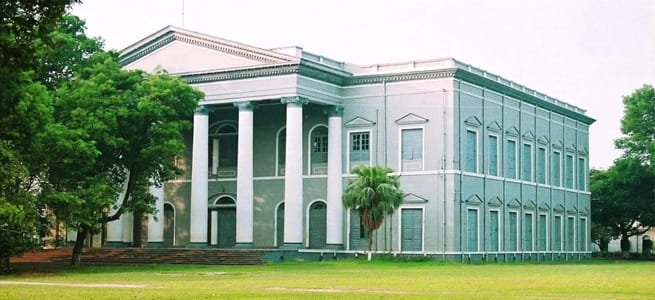
Serampore College was founded in 1818 by the missionary trio William Carey, Joshua Marshman and William Ward in Serampore, then a Danish settlement. Its place in this list rests on the Royal Danish Charter granted in 1827, which gave the institution university status and the power to confer degrees.
The structure is unusual by modern Indian standards. Its Arts, Science and Commerce wing is affiliated to the University of Calcutta, while the Senate of Serampore College functions as a university for theological education. The Serampore College Act of 1918 further defined this university role and enabled the Senate to work with affiliated theological institutions.
Because of this distinctive legal history, Serampore does not always appear in general lists of Indian universities. Yet its own official records describe it as a university under the 1827 Charter, making it the oldest institution in this ranking.
2. University of Calcutta, West Bengal – 1857
The University of Calcutta was founded on January 24, 1857, following the educational reforms associated with Wood’s Despatch of 1854. It became the first of the three great presidency universities established in India that year.
The university was originally organised broadly on the model of the University of London and functioned mainly as an affiliating and examining body. Its jurisdiction once extended over an enormous part of British India and even reached institutions beyond the boundaries of present-day India.
Over time, Calcutta University developed major teaching and research departments and became closely associated with figures such as C.V. Raman, Rabindranath Tagore, Amartya Sen and Abhijit Banerjee. Its 1857 foundation remains a landmark in the history of modern Indian higher education.
3. University of Mumbai, Maharashtra – 1857
The University of Mumbai, originally known as the University of Bombay, was established on July 18, 1857. It was one of the first three modern universities created in India, along with Calcutta and Madras.
Like the other presidency universities, it initially concentrated on examinations and affiliation rather than operating as a large teaching university. As Bombay developed into one of India’s most important commercial and cultural centres, the university expanded its academic reach and became connected with a large network of colleges.
Its history is closely tied to the growth of higher education in western India. The institution officially changed its name from the University of Bombay to the University of Mumbai in 1996, following the renaming of the city.
4. University of Madras, Tamil Nadu – 1857
The University of Madras was incorporated on September 5, 1857, by an Act of the Legislative Council of India. Its origins go back further, with an early public petition for a university in Madras submitted in 1839 and a University Board formed in 1840.
The institution was organised on the model of the University of London and became enormously influential across southern India. For decades, colleges across a vast region came under its academic jurisdiction before new universities were created in Mysore, Hyderabad, Andhra, Kerala and elsewhere.
That role earned Madras University a reputation as a mother institution for higher education in the south. It remains one of India’s most historically important state universities and the third of the three presidency universities founded in 1857.
5. Panjab University, Chandigarh – 1882
Panjab University traces its history to the University of the Punjab, established at Lahore in 1882. It was created to serve the educational needs of the Punjab region and initially functioned mainly through affiliated colleges and examinations.
Partition in 1947 transformed the institution’s geography. Lahore became part of Pakistan, and the university was re-established on the Indian side before eventually developing its permanent campus in Chandigarh. Despite this upheaval, Panjab University officially treats 1882 as the beginning of its institutional history.
The university today combines a large teaching campus with affiliated colleges in Punjab and Chandigarh. Its survival across colonial rule, Partition and the creation of a new capital gives it one of the most unusual histories among India’s oldest universities.
6. University of Allahabad, Uttar Pradesh – 1887
The University of Allahabad was established on September 23, 1887, through Act XVIII. Its official history describes it as the fourth oldest university in the conventional sequence after Calcutta, Bombay and Madras, reflecting the way nineteenth-century British Indian universities were traditionally counted.
The university grew out of plans associated with Muir Central College, whose foundation stone had been laid in 1873. In its early years, Allahabad University functioned mainly as a degree-conferring and affiliating institution before later developing into a teaching and residential university.
Because of its long academic reputation, the institution became popularly known as the ‘Oxford of the East.’ It has produced generations of scholars, administrators, judges, writers and political leaders and is today a central university.
7. Banaras Hindu University, Uttar Pradesh – 1916
Banaras Hindu University was founded in 1916 in Varanasi through the efforts of Pandit Madan Mohan Malaviya and other supporters, including Annie Besant. The legal foundation had been created by the Banaras Hindu University Act of 1915.
BHU represented a different model from the older affiliating universities. It was conceived as a large residential and teaching university that would combine traditional Indian learning with modern science, engineering, medicine, agriculture and professional education.
The university grew into one of India’s best-known multidisciplinary institutions, with a large residential campus and a wide range of faculties and institutes. Its foundation during the national movement also gave BHU an important symbolic place in the development of Indian-led higher education before independence.
8. SNDT Women’s University, Maharashtra – 1916
SNDT Women’s University was established on July 5, 1916, in Pune by social reformer Dhondo Keshav Karve. It began as the Indian Women’s University and was created specifically to expand higher education opportunities for women at a time when access remained extremely limited.
The first five women graduated from the university in 1921. Support from the Thackersey family later helped the institution grow, and it eventually took the name Shreemati Nathibai Damodar Thackersey Women’s University. It received statutory recognition in 1951.
SNDT describes itself as the first women’s university in India and South-East Asia. Today its headquarters are in Mumbai, with multiple campuses and a broad range of undergraduate, postgraduate, professional and research programmes.
9. University of Mysore, Karnataka – 1916
The University of Mysore was established on July 27, 1916, during the reign of Maharaja Nalvadi Krishnaraja Wadiyar IV. Sir M. Visvesvaraya, the celebrated engineer and Diwan of Mysore, played an important role in the effort to create the university.
Its foundation was historically significant because Mysore was a princely state rather than a directly administered province of British India. The university itself notes that it was the first university established outside the limits of British India and the first university in Karnataka.
It began with faculties in Arts and Science and gradually expanded into a broad teaching and research institution. More than a century later, the University of Mysore remains one of southern India’s most prominent public universities.
10. Patna University, Bihar – 1917
Patna University was established on October 1, 1917, under the Patna University Act. It was created to serve the growing higher-education needs of Bihar and Orissa and initially functioned as an affiliating and examining university over a very wide region.
For decades, colleges across Bihar and areas that later became separate states came under its jurisdiction. In 1952, Patna University was reorganised as a teaching-cum-residential university with a much smaller territorial area focused on metropolitan Patna.
The institution is the oldest university in Bihar and remains closely associated with the historic educational corridor along Ashok Rajpath. Its constituent colleges and postgraduate departments continue a university tradition that has now lasted for more than a century.
Why Do Rankings of India’s Oldest Universities Differ?
The answer depends on what is being counted. Some lists consider only modern universities created by legislation, which usually makes Calcutta, Mumbai and Madras the first three. Others include Serampore because its 1827 Royal Charter granted university powers, even though its present university function is specialised in theology.
Founding dates can also differ from the dates when institutions received later statutory recognition. SNDT, for example, officially celebrates 1916 as its foundation year but received statutory recognition in 1951. Panjab University presents another special case because it began in Lahore in 1882 and continued in India after Partition.
Ancient centres such as Nalanda and Takshashila are historically much older than every institution on this list, but they were not continuously operating modern universities. For that reason, they should be discussed separately rather than inserted into a chronological list of present-day universities.
Final Word
India’s oldest universities tell the story of how modern higher education developed across very different periods. Serampore represents an unusual early degree-granting tradition, the presidency universities of Calcutta, Mumbai and Madras created a new nineteenth-century system, and institutions such as Allahabad, BHU, SNDT, Mysore and Patna expanded that system into new regions and communities.
Their structures and roles have changed greatly over time, but their long histories still shape Indian higher education. More than a century after most of them were founded, these universities continue to teach, conduct research and preserve some of the country’s most important academic traditions.