Speed has always been one of the ultimate measures of automotive engineering. For decades, manufacturers have competed to cross seemingly impossible barriers, moving from 200 mph supercars to modern hypercars capable of exceeding 300 mph.
Reaching those speeds requires much more than enormous horsepower. Aerodynamics, tyre technology, cooling, stability, lightweight construction and advanced electronics must all work perfectly together. Electric hypercars have now joined this battle, challenging machines powered by some of the most sophisticated petrol engines ever created.
This ranking focuses on production and limited-production road cars that have achieved measured high-speed runs. Where different record formats were used, such as single-direction runs or two-way averages, that distinction is explained. Let’s check out the top 10 list of the fastest cars in the world.
1. Yangwang U9 Xtreme – 308.4 mph
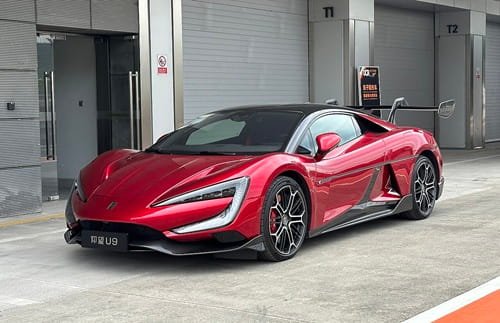
The Yangwang U9 Xtreme has rewritten the production-car speed record by achieving an extraordinary 308.4 mph, or 496.22 km/h, at Germany’s ATP Automotive Testing Papenburg facility in September 2025.
Produced by BYD’s premium Yangwang brand, the U9 Xtreme is an all-electric hypercar and will be limited to only 30 examples. Its record moved it ahead of the Bugatti Chiron Super Sport 300+, making an electric vehicle the fastest production car in the world.
The U9 Xtreme uses four electric motors producing close to 3,000 horsepower combined. Its advanced 1,200-volt electrical architecture and motors capable of spinning at up to 30,000 rpm were developed specifically to deliver extreme performance.
Special tyres, revised suspension and sophisticated active body-control technology were also required to keep the car stable as it approached 500 km/h. The achievement demonstrates how dramatically electric performance has advanced in only a few years.
2. Bugatti Chiron Super Sport 300+ – 304.773 mph
For six years, the Bugatti Chiron Super Sport 300+ represented the ultimate benchmark for production-car top speed.
In 2019, Bugatti test driver Andy Wallace reached 304.773 mph, or 490.484 km/h, at the Ehra-Lessien test track in Germany. It became the first production-derived road car to break the legendary 300 mph barrier.
The Chiron Super Sport 300+ uses Bugatti’s 8.0-litre quad-turbocharged W16 engine producing 1,600 PS. Engineers extended the rear bodywork to create a longtail shape that reduces aerodynamic drag and improves stability at extreme speeds.
Only 30 customer examples were produced. Although the Yangwang U9 Xtreme has now exceeded its speed, the Bugatti remains one of the most significant cars in automotive history because it was the machine that proved 300 mph was possible for a production hypercar.
3. SSC Tuatara – 295 mph
American manufacturer SSC pushed extremely close to the 300 mph mark when the SSC Tuatara reached 295 mph during high-speed testing in 2022.
The Tuatara had already established an independently verified two-way average of 282.9 mph during an earlier run at the Kennedy Space Center. Its later 295 mph attempt demonstrated that the car had considerably more performance available, although a return run could not be completed.
Power comes from a 5.9-litre twin-turbocharged V8 capable of producing up to approximately 1,750 horsepower on E85 fuel.
Aerodynamics are equally important. The Tuatara’s fighter-jet-inspired body was designed to combine extremely low drag with stability at very high speeds. SSC plans only 100 road-going examples, giving the car genuine limited-production status.
4. Koenigsegg Agera RS – 284.55 mph
The Koenigsegg Agera RS remains one of the most impressive high-speed cars ever tested on a public road.
During record runs in Nevada in November 2017, the Agera RS reached a maximum speed of 284.55 mph, or 457.94 km/h, in one direction. Its officially recognised two-way average was 277.87 mph.
Unlike many speed attempts conducted on closed test tracks, Koenigsegg used a section of public highway temporarily closed for the record attempt.
The Agera RS was powered by a 5.0-litre twin-turbocharged V8 producing as much as 1,360 horsepower with the optional high-output package. Extensive use of carbon fibre kept weight low, while active aerodynamics helped maintain stability.
Its 277.87 mph two-way average remains one of the most respected production-car speed achievements because the car completed runs in both directions to minimise the effects of wind and road gradient.
5. Bugatti W16 Mistral – 282 mph
The Bugatti W16 Mistral demonstrated that extreme speed does not necessarily require a fixed roof.
In November 2024, the open-top hypercar reached 282 mph, or 453.91 km/h, at the Papenburg test facility in Germany. The achievement made it the fastest open-top production car ever recorded.
The Mistral uses the final evolution of Bugatti’s legendary quad-turbocharged W16 engine, producing 1,600 PS.
Driving an open-top car at more than 450 km/h creates major aerodynamic challenges. Engineers had to ensure that airflow remained stable around the cockpit while still providing sufficient cooling for the enormous engine.
Only 99 W16 Mistrals were planned, making the model not only exceptionally fast but also one of the final road cars built around Bugatti’s famous W16 powertrain.
6. Hennessey Venom F5 – 271.6 mph
The Hennessey Venom F5 has been developed with one major ambition: exceeding 300 mph.
During testing, the American hypercar achieved 271.6 mph, or approximately 437 km/h. Hennessey has repeatedly stated that this was not intended to represent the car’s ultimate capability.
At its heart is a 6.6-litre twin-turbocharged V8 nicknamed Fury, producing an enormous 1,817 horsepower.
The lightweight carbon-fibre construction gives the Venom F5 an exceptional power-to-weight ratio, while the body was shaped specifically to minimise aerodynamic resistance at extreme speeds.
Hennessey has continued working towards a full high-speed attempt, meaning the F5 remains one of the cars most capable of changing this ranking in the future.
7. Rimac Nevera R – 268.2 mph
The Rimac Nevera R proves that the Yangwang U9 Xtreme is not the only electric hypercar capable of extraordinary top speeds.
In 2025, the Nevera R achieved a verified top speed of 268.2 mph, or 431.45 km/h, while simultaneously setting numerous acceleration and braking records.
Its four electric motors produce more than 2,000 horsepower, allowing the car to accelerate with extraordinary force almost regardless of its starting speed.
Rimac redesigned the aerodynamics compared with the standard Nevera, adding a larger rear wing, revised diffuser and other changes to increase grip and stability.
The Nevera R is particularly impressive because it combines extreme top speed with some of the quickest acceleration ever recorded by a road-going production vehicle.
8. Bugatti Veyron 16.4 Super Sport – 267.856 mph
Long before 300 mph production cars seemed realistic, the Bugatti Veyron 16.4 Super Sport established an extraordinary benchmark.
In 2010, the Veyron Super Sport achieved a two-way average of approximately 267.856 mph, or 431.072 km/h, establishing a Guinness World Records production-car speed record.
Its 8.0-litre quad-turbocharged W16 engine produced approximately 1,200 PS, considerably more than the already extraordinary original Veyron.
Bugatti modified the aerodynamics, cooling system and chassis to cope with the additional power. Carbon-fibre construction also helped reduce weight.
The Veyron Super Sport’s record demonstrated that a luxurious road car could combine comfort with performance once reserved for racing machinery and experimental prototypes.
9. Rimac Nevera – 258 mph
Before the more extreme Nevera R arrived, the original Rimac Nevera had already established itself as one of the fastest electric cars ever built.
In November 2022, it reached a verified 258 mph, or 412 km/h, at the Papenburg test facility.
The Nevera uses four individually controlled electric motors producing 1,914 horsepower. Sophisticated torque vectoring allows the car to continuously adjust how much power is delivered to each wheel.
Its top-speed run was completed on road-legal tyres using precision GPS measuring equipment. Customer cars are normally electronically restricted to a lower speed, with the full top-speed mode intended for specially controlled events.
Only 150 Neveras were planned, making the Croatian electric hypercar a rare machine as well as an important milestone in EV performance.
10. SSC Ultimate Aero – 256.14 mph
The SSC Ultimate Aero completes the top ten with an officially recorded two-way average speed of approximately 256.14 mph.
In September 2007, the American supercar completed runs in opposite directions on a closed public road in Washington State. Guinness World Records subsequently recognised it as the world’s fastest production car, taking the title away from the original Bugatti Veyron.
The Ultimate Aero used a twin-turbocharged V8 producing more than 1,180 horsepower while weighing considerably less than many modern hypercars.
What makes its achievement particularly impressive is the relative simplicity of the car compared with today’s electronically sophisticated machines. Its success laid the foundations for SSC’s later Tuatara and established the small American company as a serious contender in the global top-speed race.
What Makes the World’s Fastest Cars So Fast?
Breaking through 250, 280 or 300 mph requires far more than simply fitting a car with a more powerful engine.
Enormous power: Modern record-setting hypercars can produce between 1,200 and almost 3,000 horsepower.
Low aerodynamic drag: At extreme speeds, air resistance becomes one of the biggest obstacles to further acceleration.
High-speed stability: Wings, diffusers, active suspension and carefully shaped bodywork prevent cars from becoming unstable as speed increases.
Special tyres: Tyres experience enormous heat and centrifugal forces above 250 mph and must be developed specifically for these conditions.
Lightweight construction: Carbon fibre and other advanced materials reduce weight while maintaining structural strength.
Advanced cooling: Engines, electric motors, batteries and transmissions generate enormous heat during prolonged maximum acceleration.
Long test facilities: Finding a sufficiently long and safe location is itself difficult. Only a handful of tracks and closed roads around the world can accommodate speeds approaching 300 mph.
Final Word
The battle for the world’s fastest car has entered a new era. The Yangwang U9 Xtreme now leads at 308.4 mph, narrowly surpassing the Bugatti Chiron Super Sport 300+ and becoming the first electric production car to hold the overall top-speed crown.
Bugatti, SSC, Koenigsegg, Hennessey and Rimac remain close behind, and with several manufacturers still chasing higher speeds, the 310 mph barrier may not remain untouched for long.