Evaporation concentrates products and removes solvents at many stages of chemical manufacturing. It also uses significant energy, time and operator attention. Continuous and semi-continuous systems reduce these costs by processing material in thin films under vacuum.
Two designs lead this shift. A rotary film evaporator handles bulk solvent removal at pilot and production scale. Wiped film technology processes heat-sensitive and viscous feeds in a single short pass. Both designs bring clear gains in energy, yield and throughput.
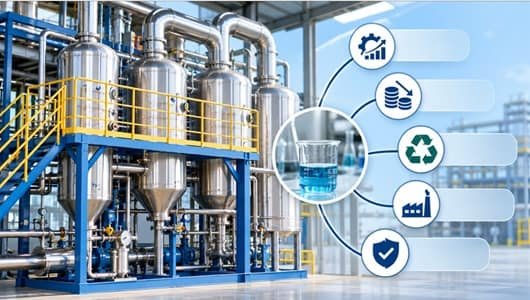
Why Evaporation Shapes Production Cost and Throughput
Batch evaporation repeats heating, cooling, charging and emptying for every lot. Each cycle adds downtime and exposes the product to heat for long periods. Operators also spend valuable time monitoring every step.
Long heat exposure can degrade sensitive compounds and lower yield. Large volumes of hot liquid also raise energy demand and safety risk. Steady-state operation addresses each of these issues. Faster, gentler evaporation improves throughput, product quality and plant safety together.
How Continuous Thin-Film Evaporation Works
Thin-film systems share five working principles:
- Thin Liquid Film: A heated surface spreads the feed into a layer a few millimetres thick.
- Vacuum Operation: Reduced pressure lowers boiling points and protects heat-sensitive compounds.
- Controlled Heating: Jacketed walls or heating baths supply even, controlled heat.
- Short Residence Time: Feed passes over the heated surface quickly, which limits thermal stress.
- Continuous Vapour Removal: Condensers recover the solvent while the concentrate leaves separately.
Together, these principles raise heat transfer rates and protect product quality.
Scaling Solvent Removal with Rotary Film Evaporators
A rotary film evaporator rotates its flask in a heated bath. The rotation spreads liquid as a thin film on the inner wall. Vacuum then draws solvent vapour to a condenser and receiver. Many units accept continuous feed under vacuum, giving semi-continuous operation over long runs.
At larger scale, manufacturers such as Goel Scientific Glass Works Ltd. offer jumbo units with cylindrical borosilicate flasks up to 400 litres. The cylindrical shape reduces mechanical stress and simplifies cleaning compared with large spherical flasks. Large units typically pair variable-speed drives with flameproof heating baths for solvent safety.
Wiped Film Evaporators for Heat-Sensitive and Viscous Feeds
A wiped film evaporator spreads feed on the inside of a heated, vertical cylinder. Rotating wipers keep the film thin and turbulent. Mechanical seals hold the vacuum tight around the wiper shaft. Concentrate flows to the bottom while vapour moves to a condenser.
Residence time stays very short, which suits vitamins, enzymes, aromatics and viscous residues. For example, manufacturers such as Goel Scientific Glass Works Ltd. offer glass wiped film evaporator units from DN 80 to DN 300. Thermic fluid heats their jackets up to 150 °C. These units cover laboratory to production scale.
Where the Efficiency Gains Come From
Continuous thin-film systems improve efficiency in six areas:
- Energy Use: Lower boiling points under vacuum reduce heating demand.
- Product Yield: Short heat exposure limits degradation and by-product formation.
- Throughput: Steady feed removes start-up and shutdown time between batches.
- Labour: Automated feed and discharge reduce manual handling.
- Footprint: Thin-film units deliver high capacity from a small floor area.
- Solvent Recovery: Condensed solvent returns to the process for reuse.
These gains build up across many production campaigns.
Choosing the Right Evaporation System
Each design suits different duties:
| Design | Operating Mode | Best Suited To |
| Rotary film | Batch or semi-continuous | Bulk solvent removal and concentration |
| Wiped film | Continuous | Heat-sensitive or viscous products |
| Falling film | Continuous | Clean, low-viscosity liquids |
Feed viscosity, heat sensitivity and target concentration guide the decision. Pilot trials with real feed confirm the right choice before scale-up.
Linking Evaporation with Solvent Recovery and Distillation
Evaporation often forms one step in a wider recovery train. Condensed solvent can feed a distillation column for further purification before reuse. Recovered solvent then cuts fresh solvent purchases and waste disposal costs.
Glass systems suit this integration because borosilicate resists most solvents and acids. Glass also keeps product contact surfaces inert. Operators can watch boiling, film formation and condensation directly. This visibility supports faster troubleshooting during commissioning and routine operation.
Operating Practices for Safe, Efficient Evaporation
Good practice keeps thin-film systems at peak performance:
- Vacuum Control: Stable vacuum keeps boiling temperatures steady.
- Feed Rate Control: Matching feed to evaporation capacity keeps the film even.
- Condenser Capacity: Adequate cooling captures solvent and protects vacuum pumps.
- Routine Cleaning: Regular cleaning keeps heat transfer surfaces efficient.
Consistent practices keep performance stable across campaigns.
Conclusion
Continuous and semi-continuous evaporation cuts downtime, protects product quality and lowers energy use. Thin films, vacuum and short residence times make these gains possible across chemical production. Glass construction adds visibility and corrosion resistance at every stage.
Rotary units suit bulk solvent removal, while wiped film designs handle sensitive and viscous feeds. Matching the system to the feed, then testing at pilot scale, gives plants a reliable path to efficient production.