Someone might ask you, “Is Delhi Metro driverless?” and honestly, it’s a fair question. The Delhi Metro Rail Corporation has introduced advanced technology over the years, so the system often feels highly automated. Because trains arrive on time and operate smoothly, many passengers assume that no driver is involved.
Moreover, modern metro systems around the world now use driverless technology. At the same time, Delhi Metro has also started adopting similar systems on selected routes. Therefore, the answer is not a simple yes or no—it depends on the metro line.
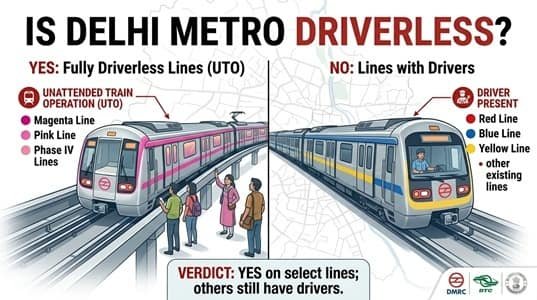
Delhi Metro is partially driverless. Some lines operate with fully automated systems, while others still require train operators.
For example, newer lines like the Magenta Line and Pink Line support driverless operations. However, older lines such as the Blue Line and Yellow Line still use human drivers. Therefore, the system combines both traditional and modern technology.
Which Lines Are Driverless?
Magenta Line (Janakpuri West – Botanical Garden)
The Magenta Line was the first to introduce driverless technology. Therefore, it marked a major step forward.
Pink Line (Majlis Park – Shiv Vihar)
This line also supports driverless train operations. As a result, it improves efficiency and reduces human dependency.
On these lines, trains can run automatically. However, staff may still remain onboard for safety and supervision.
Which Lines Still Have Drivers?
Older lines continue to operate with drivers. These include:
- Yellow Line
- Blue Line
- Red Line
- Green Line
- Violet Line
Because these lines were built earlier, they use older technology. Therefore, upgrading them to driverless systems takes time and investment.
What Technology Makes It Driverless?
CBTC System (Communication-Based Train Control)
Driverless trains rely on CBTC technology. This system allows trains to communicate with control centers in real time.
As a result:
- Trains maintain safe distance automatically
- Speed adjusts without human input
- Operations remain smooth and efficient
Automated Train Operation (ATO)
ATO controls acceleration, braking, and stopping. Therefore, trains operate precisely at platforms.
Is There Really No Driver?
Even on driverless lines, staff may still be present. However, they do not actively control the train.
Instead, they:
- Monitor operations
- Handle emergencies
- Assist passengers if needed
Therefore, the term “driverless” refers to automated control rather than complete absence of staff.
Advantages of Driverless Metro
Better Efficiency
Automated systems reduce human error. Therefore, trains operate more consistently.
Improved Safety
Technology ensures safe distance and speed. As a result, accidents become less likely.
Higher Frequency
Driverless systems allow more trains to run. Therefore, waiting time decreases.
Energy Efficiency
Automated control optimizes energy usage. Consequently, operations become more sustainable.
Challenges of Driverless Systems
High Cost
Installing advanced technology requires heavy investment. Therefore, expansion takes time.
Maintenance Complexity
Automated systems need regular maintenance. As a result, technical expertise becomes essential.
Public Trust
Some passengers feel unsure about driverless trains. Therefore, awareness and education remain important.
Real-Life Experience
Passengers traveling on driverless lines often notice smoother rides. Trains stop accurately, and announcements remain clear.
Moreover, the experience feels modern and efficient. However, many passengers still look for a driver out of habit. Therefore, the transition feels gradual rather than sudden.
Future of Driverless Metro in Delhi
Delhi Metro plans to expand driverless technology further. New lines will likely adopt automation from the beginning.
Moreover, existing lines may also upgrade over time. As a result, more parts of the network could become driverless in the future.
Why This Question Matters
Understanding whether Delhi Metro is driverless helps passengers trust the system. Moreover, it highlights how technology improves daily travel.
In addition, awareness of automation trends shows how cities evolve. Therefore, this topic remains relevant for modern urban life.
Conclusion
Delhi Metro is not completely driverless, but it has taken strong steps toward automation. Some lines already operate without drivers, while others continue using traditional systems. Therefore, the network combines both approaches.
Moreover, driverless technology improves efficiency and safety. In conclusion, Delhi Metro continues to evolve, and driverless operations will likely expand in the coming years.
FAQs
Q1. Is Delhi Metro fully driverless?
No, it is only partially driverless.
Q2. Which lines are driverless?
The Magenta Line and Pink Line support driverless operations.
Q3. Do driverless trains have staff onboard?
Yes, staff remain present for safety and assistance.
Q4. What technology is used?
CBTC and Automated Train Operation systems.
Q5. Are older lines driverless?
No, older lines still use human drivers.
Q6. Is driverless metro safe?
Yes, it is considered very safe due to advanced technology.
Q7. Will all lines become driverless?
Possibly in the future, but it will take time.
Q8. Why do people think it is driverless?
Because trains run smoothly and automatically.