If you’re planning furniture or interiors, you’ll almost always hear these three names—MDF, plywood, and particle board. On the surface, they may look similar once polished or laminated. But inside, they are very different. And those differences decide how long your furniture will last, how much it can handle, and how much maintenance it will need.
In Indian homes, this choice becomes even more important because of humidity, heat, and daily heavy usage. Many people choose the cheaper option first and then face swelling, bending, or breakage later. So it’s worth understanding each material properly before making a decision.
Let’s go step by step and compare them across all major aspects.
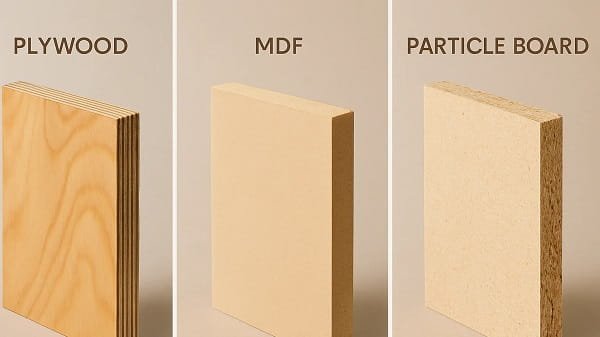
What Are These Materials?
- Plywood is made by gluing thin layers of wood veneer together. These layers are placed in alternating directions, which gives it strength and stability.
- MDF (Medium Density Fiberboard) is made from fine wood fibers mixed with resin and pressed into sheets. It has a smooth and uniform surface.
- Particle Board is made from wood chips, sawdust, and adhesive pressed together. It is the most basic and lowest-cost option among the three.
1. Strength and Durability
This is the biggest difference.
- Plywood is the strongest. Because of its layered structure, it can handle heavy weight and daily use without bending or breaking easily. It is ideal for beds, kitchen cabinets, and structural furniture.
- MDF is moderately strong. It is denser than particle board but weaker than plywood. It works well for light to medium use, like cabinets or decorative panels.
- Particle Board is the weakest. It cannot handle heavy loads for long and may sag over time.
Verdict: Plywood > MDF > Particle Board
2. Moisture Resistance
In Indian conditions, this matters a lot.
- Plywood, especially BWR or BWP grade, offers good resistance to moisture. It performs well in kitchens and areas with occasional water exposure.
- MDF does not handle water well. It can swell and lose strength if exposed to moisture.
- Particle Board is the most vulnerable. Even small amounts of water can damage it quickly.
Verdict: Plywood is the best choice for moisture-prone areas
3. Cost and Budget
Here’s where things change.
- Particle Board is the cheapest. It is often used in low-cost furniture.
- MDF is slightly more expensive than particle board but still affordable.
- Plywood is the most expensive among the three, especially high-quality grades.
Verdict: Particle Board < MDF < Plywood
4. Surface Finish and Appearance
- MDF has the smoothest surface. It is perfect for painted finishes and modern designs. That’s why it is widely used for decorative panels and cabinets.
- Plywood has a slightly rough surface compared to MDF, but it can be finished well with laminates or veneers.
- Particle Board has the least refined surface and often needs proper lamination to look good.
Verdict: Best for smooth finish → MDF
5. Workability and Design Flexibility
- MDF is very easy to cut, shape, and design. It is ideal for intricate patterns and CNC work.
- Plywood is also workable but not as smooth for detailed carving.
- Particle Board is easy to cut but not very reliable for detailed or strong designs.
Verdict: Best for design work → MDF
6. Screw Holding Capacity
This is often ignored but very important.
- Plywood holds screws very well. This makes it strong and long-lasting.
- MDF has moderate screw-holding capacity.
- Particle Board performs poorly. Screws can loosen over time.
Verdict: Plywood is the most reliable
7. Weight and Handling
- MDF is quite heavy due to its density.
- Plywood is lighter compared to MDF but still strong.
- Particle Board is usually lighter but also weaker.
Verdict: Easiest balance of strength and weight → Plywood
8. Lifespan
- Plywood can last for many years, even decades with proper care.
- MDF has a moderate lifespan, depending on usage and exposure.
- Particle Board has the shortest lifespan, especially in Indian conditions.
Verdict: Longest life → Plywood
9. Best Use Cases
Plywood is best for:
- Kitchen cabinets
- Beds and wardrobes
- Doors and structural furniture
MDF is best for:
- Decorative panels
- Painted furniture
- TV units and shelves (light use)
Particle Board is best for:
- Temporary furniture
- Low-cost setups
- Office furniture with limited use
Final Thoughts
There is no one-size-fits-all answer, but the difference becomes clear when you look at usage.
- If you want strength, durability, and long-term value → go for plywood
- If you want smooth finish and modern design at a moderate price → choose MDF
- If your priority is low cost and short-term use → particle board can work
A smart approach is to mix materials. Use plywood where strength matters, MDF where design matters, and avoid particle board for anything important.
In the end, choosing the right material is not about saving money today—it’s about avoiding problems tomorrow.