Gas fees are an important concept in the cryptocurrency and blockchain industry. Anyone who sends cryptocurrency, swaps tokens, uses a decentralized application (dApp), mints an NFT, or interacts with a smart contract may encounter transaction fees. On some blockchain networks, these fees are commonly referred to as gas fees.
For beginners, gas fees can be confusing. Why do users have to pay them? Who receives the money? Why does the fee sometimes increase dramatically? Does every cryptocurrency charge gas fees?
The answer depends on the blockchain network. The term “gas” is most strongly associated with Ethereum and Ethereum-compatible networks, where gas represents the computational work required to execute transactions and smart-contract operations.
In this article, we will explain what gas fees are, how they work, why they change, how Ethereum gas is calculated, who receives the fees, examples of gas fees, ways to reduce them, and the risks beginners should understand.
What Are Gas Fees?
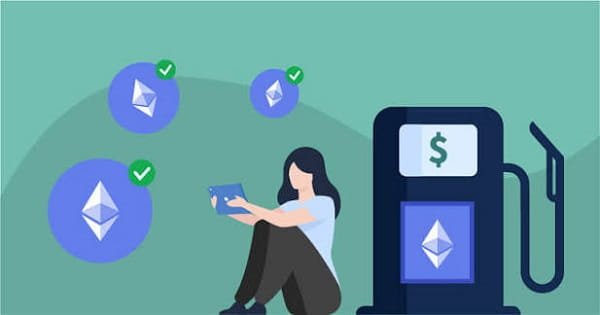
Gas fees are charges paid by users to compensate the blockchain network for processing transactions and performing computational operations.
Think of gas as the fuel required to operate a blockchain network.
When you send ETH, transfer a token, swap assets through a decentralized exchange, or interact with a smart contract, the blockchain must perform computational work.
The user pays a fee for that work.
On Ethereum, gas is measured in units, while the fee itself is paid in ETH.
For example, a simple transaction may require less computational work than a complex smart-contract interaction. Therefore, the amount of gas required can differ depending on the transaction.
Why Are Gas Fees Necessary?
Gas fees serve several important purposes.
1. Paying Network Participants
Transaction fees provide economic incentives for participants who help process and secure the blockchain.
On Ethereum, validators participate in the network’s Proof-of-Stake consensus system.
2. Preventing Spam
If transactions were completely free, malicious users could potentially send enormous numbers of unnecessary transactions and overload the network.
Fees make such activity more expensive.
3. Measuring Computational Work
Different blockchain operations require different amounts of computational resources.
Gas provides a way to measure and price this work.
4. Prioritizing Transactions
When network demand is high, users may compete by offering higher effective fees to have transactions processed more quickly.
How Do Ethereum Gas Fees Work?
Ethereum uses gas to measure the computational resources required to execute an operation.
A transaction requires a certain amount of gas.
The amount of ETH paid depends on the gas used and the applicable gas price.
A simplified representation is:
Transaction Fee = Gas Used × Effective Gas Price
For example, suppose a transaction uses 21,000 units of gas and the effective gas price is 20 gwei.
The calculation would be:
21,000 × 20 gwei = 420,000 gwei
Since 1 ETH equals 1 billion gwei, this would equal:
0.00042 ETH
The actual fee structure on Ethereum is more sophisticated because of the network’s fee mechanism and transaction parameters.
What Is Gwei?
Gwei is a small denomination of Ether.
It is commonly used when discussing Ethereum gas prices because gas prices are often much smaller than one ETH.
The relationship is:
1 ETH = 1,000,000,000 gwei
Using gwei makes gas prices easier to read.
For example, saying “30 gwei” is more practical than expressing the same price as a very small fraction of ETH.
What Determines Gas Fees?
Gas fees are influenced by several factors.
1. Network Demand
One of the biggest factors is demand for blockchain space.
When many users want their transactions processed at the same time, competition for block space can increase.
This can result in higher effective fees.
2. Transaction Complexity
A simple ETH transfer generally requires less computational work than a complicated smart-contract interaction.
For example, swapping tokens through a decentralized exchange may require multiple contract operations and therefore use more gas.
3. Block Capacity
Blockchains have limits on how much transaction data and computational work can be included in each block.
When demand approaches these limits, fees can rise.
4. User Fee Settings
Depending on the wallet and blockchain, users may have options affecting how quickly a transaction is processed.
Higher fee settings can sometimes result in faster inclusion, while lower settings may cause a transaction to wait longer.
What Is Ethereum’s Base Fee?
Ethereum introduced a fee mechanism through EIP-1559 that changed how transaction fees are structured.
Under this system, the Ethereum transaction fee includes a base fee determined by the network and a priority fee that can be offered to the validator.
The base fee is generally burned, meaning the corresponding ETH is removed from circulation.
The priority fee, often called a tip, is paid to the validator.
This mechanism helps make Ethereum’s fee market more predictable than the older auction-style system, although actual transaction costs can still vary significantly depending on network demand.
What Is a Priority Fee?
A priority fee is an additional amount a user can offer to encourage a validator to include a transaction.
It is sometimes referred to as a tip.
When the network is busy, users may increase the priority fee if they want their transaction to be processed more quickly.
However, paying a higher fee does not necessarily guarantee immediate confirmation because network conditions and transaction settings also matter.
Do All Cryptocurrencies Have Gas Fees?
No.
Not every cryptocurrency uses the term “gas fee.”
Different blockchain networks use different fee structures.
For example, Bitcoin generally refers to transaction fees rather than gas fees.
Ethereum uses the concept of gas to measure computational work.
Other blockchain networks have their own fee models and units.
Therefore, it is important to understand the specific blockchain being used.
Gas Fees for Different Transactions
Gas requirements can vary significantly depending on what a user is doing.
1. Sending ETH
A basic ETH transfer is generally less computationally complex than many smart-contract operations.
2. Sending Tokens
Transferring an ERC-20 token requires interaction with the token’s smart contract, so it can use more gas than a simple ETH transfer.
3. Token Swaps
Swapping one token for another through a decentralized exchange can involve multiple smart-contract operations.
Therefore, it can require significantly more gas.
4. NFT Transactions
Minting, buying, selling, or transferring NFTs can also require blockchain transactions and associated fees.
5. DeFi Transactions
Lending, borrowing, providing liquidity, staking through smart contracts, and other DeFi activities can involve multiple contract interactions and therefore potentially higher gas costs.
Why Do Gas Fees Become So High?
Gas fees can become expensive when there is heavy demand for blockchain transactions.
For example, suppose a popular NFT collection launches or a major decentralized finance event causes thousands of users to interact with Ethereum simultaneously.
The amount of available block space is limited.
Users may compete for inclusion by offering higher fees.
As a result, the effective cost of transactions can increase significantly.
This is one reason users should check current network conditions before making a transaction.
How Can You Reduce Gas Fees?
There are several ways users may be able to reduce transaction costs.
1. Choose Less Busy Times
If the blockchain is experiencing lower demand, transaction fees may be lower.
2. Use Layer 2 Networks
Ethereum Layer 2 networks can process transactions using additional infrastructure and settle or anchor activity to Ethereum.
They can often provide lower transaction costs than conducting the same activity directly on Ethereum’s main network, although users should understand the specific risks and fees involved.
3. Avoid Unnecessary Transactions
Users can reduce costs by avoiding unnecessary on-chain activity.
4. Check Fees Before Confirming
Most modern wallets display an estimated transaction fee before a transaction is submitted.
Users should review this amount carefully.
5. Compare Networks
If an asset or application supports multiple networks, users may be able to choose a network with lower fees.
However, the recipient or application must support the selected network.
What Happens If You Set the Gas Fee Too Low?
If a user submits a transaction with an insufficient fee, the transaction may take longer to be included in a block.
Depending on the network and wallet, the transaction may remain pending until network conditions change or the user replaces it with a transaction using different fee parameters.
Users should avoid repeatedly submitting transactions without understanding how their wallet handles pending transactions because this can create additional confusion.
Gas Fees and Failed Transactions
An important point for beginners is that a failed smart-contract transaction can still consume gas.
This is because validators and network nodes may have already performed computational work before the transaction ultimately failed.
Therefore, a failed transaction does not necessarily mean that the network did no work.
Users should understand that transaction fees are generally paid for network computation and processing, not simply for successful outcomes.
Gas Fees vs Exchange Fees
Gas fees and cryptocurrency exchange fees are different.
Gas fees are associated with processing transactions on a blockchain.
Exchange fees are charges imposed by a cryptocurrency exchange for services such as buying, selling, or trading digital assets.
For example, if you purchase ETH on an exchange and keep it there, you may pay an exchange trading fee.
If you later withdraw ETH to your personal wallet, the exchange may charge a withdrawal fee, which may reflect blockchain transaction costs.
Understanding the difference helps users calculate the true cost of cryptocurrency transactions.
Are Gas Fees a Problem for Cryptocurrency?
High transaction fees can create challenges for blockchain adoption.
If fees become too expensive, small transactions may no longer be practical.
This can affect everyday payments, gaming applications, NFT transactions, and DeFi users.
Ethereum and the broader blockchain industry have therefore focused heavily on scalability solutions, including Layer 2 networks and other technical improvements designed to increase transaction capacity and reduce costs.
Final Thoughts
Gas fees are an essential part of many blockchain ecosystems, especially Ethereum. They compensate network participants for processing transactions and executing smart contracts while helping prevent spam and excessive network usage.
The amount a user pays depends on factors such as gas used, network demand, transaction complexity, and the effective fee rate.
Ethereum’s EIP-1559 fee mechanism introduced a base fee and priority fee structure, with the base fee generally being burned and the priority fee going to the validator.
For beginners, the most important thing to remember is that gas fees are not simply a fixed charge for using cryptocurrency. They can change depending on the blockchain, the transaction, and current network conditions.
Before confirming a transaction, always check the network, estimated fee, recipient address, and transaction details. Understanding gas fees can help cryptocurrency users avoid unexpected costs and make better decisions when using wallets, decentralized applications, DeFi platforms, and blockchain networks.