India is home to some of the most spectacular high-altitude landscapes on Earth. From the towering Himalayas of Sikkim and Uttarakhand to the remote Karakoram mountains of Ladakh, several Indian peaks rise well above 7,000 metres and rank among Asia’s great mountains.
For consistency, this ranking uses major summits with at least about 500 metres of topographic prominence, rather than counting every minor subsidiary summit. Some Karakoram peaks lie in sensitive or disputed border regions, so their location requires geographical context. K2 is not included because its summit lies outside Indian-administered territory, although India claims the wider Kashmir region. Kangchenjunga therefore ranks as the highest mountain peak associated with Indian-administered territory.
Let’s check out the top 10 list of the highest mountain peaks in India.
1. Kangchenjunga – 8,586 Metres
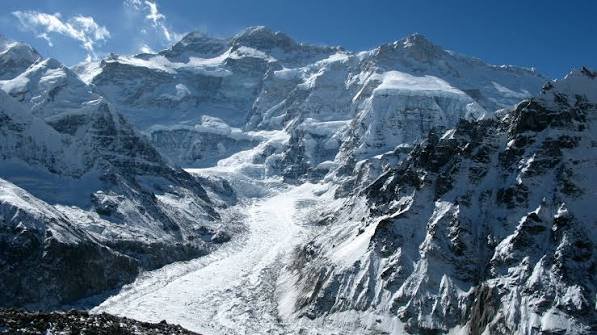
Kangchenjunga, standing at 8,586 metres or 28,169 feet, is the highest mountain peak in India and the third-highest mountain in the world, after Mount Everest and K2.
The enormous Kangchenjunga massif lies on the border between Sikkim and Nepal. Its name is commonly interpreted as the “Five Treasures of the Great Snow”, referring to the mountain’s prominent summits.
British climbers Joe Brown and George Band made the first successful ascent in 1955. In accordance with a promise made to the Chogyal of Sikkim, they stopped just short of the true summit because the mountain is considered sacred, a tradition later climbers have generally respected.
Its glaciers, enormous ridges and dramatic elevation make Kangchenjunga one of the most impressive mountain systems anywhere in the Himalayas.
2. Nanda Devi – 7,816 Metres
Nanda Devi rises to 7,816 metres or 25,643 feet in Uttarakhand and is the highest mountain located entirely within India.
The peak forms the centrepiece of the Nanda Devi mountain sanctuary, a spectacular ring of high mountains surrounding a difficult-to-access inner basin. The surrounding landscape forms part of the internationally recognised Nanda Devi National Park region.
Nanda Devi was first climbed in 1936 by British mountaineers Bill Tilman and Noel Odell. At the time, it was the highest mountain ever successfully climbed.
Its combination of altitude, isolation and steep terrain made Nanda Devi one of the great objectives of early Himalayan mountaineering. Today, access to the environmentally sensitive inner sanctuary is heavily restricted.
3. Kamet – 7,756 Metres
Kamet is India’s third-highest major peak, reaching 7,756 metres or around 25,446 feet in Uttarakhand.
It stands in the Garhwal Himalayas close to the Tibetan Plateau and is characterised by a massive pyramid-shaped summit surrounded by glaciers and other high peaks.
Kamet has an important place in mountaineering history. A British expedition led by Frank Smythe achieved the first ascent in 1931, making it one of the highest mountains successfully climbed anywhere in the world at that time.
The mountain remains an extremely serious expedition because of its altitude, unpredictable weather, glaciers and remote approach.
4. Saltoro Kangri – 7,742 Metres
Saltoro Kangri rises approximately 7,742 metres or 25,400 feet in the Saltoro Mountains of the Karakoram.
The peak lies in the highly sensitive Siachen sector, along the Actual Ground Position Line separating areas controlled by India and Pakistan. India controls the high ground around the peak, while Pakistan also claims the territory.
Saltoro Kangri is considerably more remote than famous Himalayan climbing destinations. Glaciers, severe weather, military restrictions and extreme altitude make access exceptionally difficult.
Its first ascent was made in 1962 by a Japanese-Pakistani expedition. The mountain remains one of the highest and least accessible major peaks connected with Indian-controlled territory.
5. Saser Kangri I – 7,672 Metres
Saser Kangri I stands 7,672 metres or about 25,171 feet above sea level in Ladakh.
It is the highest summit of the Saser Muztagh, the easternmost major subrange of the Karakoram. The mountain lies between the Nubra and Shyok river systems in an exceptionally rugged region.
Indian mountaineers had attempted the mountain several times before an Indo-Tibetan Border Police expedition finally succeeded in 1973.
Saser Kangri’s great height is combined with long glacier approaches, technical snow-and-ice climbing and unpredictable Karakoram weather. The Himalayan Club describes the Saser group as one of the major high-altitude mountain groups of eastern Ladakh.
6. Mamostong Kangri – 7,516 Metres
Mamostong Kangri reaches approximately 7,516 metres or 24,659 feet in the eastern Karakoram of Ladakh.
The peak is part of the remote mountain country north of the Nubra Valley and close to several large Karakoram glacier systems.
Mamostong Kangri was first climbed in 1984 by an Indo-Japanese expedition. Its remoteness meant that it remained comparatively little explored even during the period when many major Himalayan summits had already been climbed.
Reaching the mountain requires a full expedition rather than an ordinary trekking journey. High altitude, crevassed glaciers, isolation and difficult weather make Mamostong Kangri one of India’s most demanding mountain environments.
7. Saser Kangri II East – 7,513 Metres
Saser Kangri II East rises to approximately 7,513 metres or 24,649 feet, making it another giant of Ladakh’s Saser Karakoram.
It belongs to the same massif as Saser Kangri I but is recognised as a major summit in its own right because of its substantial topographic prominence.
The mountain attracted considerable attention from elite climbers because its principal eastern summit remained unclimbed long after most mountains of comparable height had been conquered.
After unsuccessful attempts, an expedition finally completed the first ascent of the higher eastern summit in 2011. Its steep faces and isolated location helped establish Saser Kangri II as one of the great modern high-altitude climbing challenges.
8. Saser Kangri III – 7,495 Metres
Saser Kangri III stands approximately 7,495 metres or 24,590 feet high, also within the Saser group in Ladakh.
Despite being only slightly lower than Saser Kangri II, it remained unclimbed until the 1980s because of the difficult terrain and isolation of the eastern Karakoram.
An Indo-Tibetan Border Police expedition climbed Saser Kangri III in 1986, completing one of the important Indian mountaineering achievements in the region.
The mountain is surrounded by an extensive network of glaciers that ultimately drain towards the Shyok and Nubra river systems. Its steep snow-and-ice terrain demands advanced expedition experience rather than conventional trekking skills.
9. Teram Kangri I – 7,462 Metres
Teram Kangri I reaches approximately 7,462 metres or 24,482 feet in the remote Siachen Karakoram.
The mountain lies near the northern part of the Siachen region and close to the boundary between Indian-controlled territory and the China-administered Trans-Karakoram area, making its geography particularly sensitive.
A Japanese expedition completed the first ascent of Teram Kangri I in 1975, together with an ascent of neighbouring Teram Kangri II.
Few people ever see the mountain at close range. Military restrictions, massive glaciers and its exceptionally isolated position make Teram Kangri very different from better-known Himalayan peaks accessible from populated valleys.
10. Jongsong Peak – 7,462 Metres
Jongsong Peak is another approximately 7,462-metre summit and completes the top ten.
It lies in the Kangchenjunga region near the meeting point of India, Nepal and Tibet, making it one of the most geographically unusual major peaks in the Himalayas.
Jongsong also holds an important place in mountaineering history. An international expedition reached the summit in 1930, and for a short period it was the highest mountain ever successfully climbed before the first ascent of Kamet the following year.
Indian expeditions have subsequently approached the mountain through the extremely remote northern Sikkim valleys. The Himalayan Club describes Jongsong’s main summit as forming the world’s highest international triple-border point.
What Makes India’s Highest Mountain Peaks So Remarkable?
India’s highest mountains stand out for far more than their elevations.
Extreme altitude: Every mountain in the top ten rises above 7,400 metres, where oxygen levels are dramatically lower than at sea level.
Himalayan and Karakoram geography: India contains sections of two of the world’s greatest high-mountain systems.
Massive glaciers: Many of these mountains are surrounded by extensive ice fields that feed important rivers across northern India.
Remote locations: Peaks in eastern Ladakh and the Siachen region are among the most isolated mountains in Asia.
Mountaineering history: Nanda Devi, Kamet, Jongsong and the Saser peaks played significant roles in the development of high-altitude climbing.
Cultural importance: Mountains such as Kangchenjunga and Nanda Devi are deeply connected with local religious traditions and cultural beliefs.
Sensitive ecosystems: High Himalayan regions contain rare wildlife and fragile ecosystems that require strict conservation.
Final Word
India’s highest peaks showcase the extraordinary scale of the Himalayas and Karakoram. Kangchenjunga leads at 8,586 metres, while Nanda Devi remains the highest mountain situated entirely within India.
From the famous mountains of Sikkim and Uttarakhand to the rarely visited giants of Ladakh, these peaks represent some of the most dramatic and challenging mountain landscapes on Earth.