India’s great temples are centres of faith, history and culture, but some also manage extraordinary financial resources. Over generations, devotees have offered cash, gold, jewellery and land, while modern temple trusts earn income from donations, investments, accommodation, prasadam and other pilgrim services.
There is no official all-India ranking that values every temple on the same basis. Some trusts publish audited assets and annual income, while ancient temples may hold priceless jewellery, land or treasury collections that have never received a complete modern valuation. The list below therefore uses the strongest publicly available indicators – disclosed trust assets, treasury estimates, bank deposits, land, corpus funds and recent income – and the positions beyond the top entries should be read as approximate.
So, let’s check out the Top 10 Richest Temples in India and see how these remarkable religious institutions accumulated and manage wealth running from hundreds of crores to more than Rs 2 lakh crore.
1. Tirumala Venkateswara Temple, Andhra Pradesh – TTD Net Worth About Rs 2.26 Lakh Crore
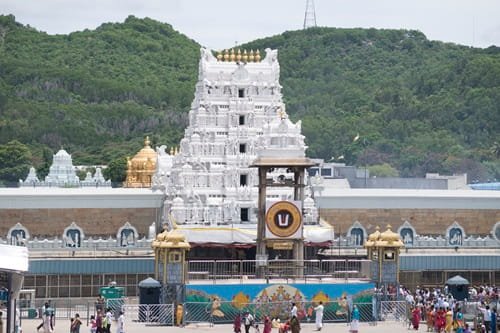
Tirumala Venkateswara Temple, popularly known as Tirupati Balaji, stands at the top when India’s richest temples are compared by the disclosed financial strength of their managing trust. The Tirumala Tirupati Devasthanams (TTD) released a white paper placing its net worth at about Rs 2.26 lakh crore.
The trust’s holdings include bank deposits, gold, jewellery, land and hundreds of properties. Earlier disclosures reported more than 10 tonnes of gold deposited with banks and cash deposits running into tens of thousands of crores. TTD also operates on a scale unmatched by most religious institutions in India.
For 2026-27, TTD approved an annual budget of Rs 5,456.26 crore. Hundi offerings remain a major source of revenue, but the organisation also earns from accommodation, prasadam, interest and other services. Its combination of huge accumulated assets and multibillion-rupee annual operations makes Tirupati India’s strongest temple trust financially.
2. Sree Padmanabhaswamy Temple, Kerala – Treasury Estimated Above Rs 1.2 Lakh Crore
Sree Padmanabhaswamy Temple in Thiruvananthapuram occupies a category of its own. Unlike Tirupati, its fame as one of the world’s richest religious sites comes primarily from the extraordinary treasure stored in underground vaults beneath the temple.
A court-supervised inventory brought global attention to collections of gold ornaments, coins, precious stones, ceremonial objects and other historic valuables. Widely reported estimates placed the material value of the inventoried treasure above Rs 1.2 lakh crore, while many pieces may carry additional antique and cultural value that cannot be measured simply by their metal content.
Vault B was not opened as part of the modern inventory process, adding another layer of uncertainty to any total estimate. For this reason, Padmanabhaswamy is often described as the richest temple by accumulated treasure, even though its yearly operating income is not comparable with TTD’s huge annual budget.
3. Shirdi Sai Baba Temple, Maharashtra – Estimated Assets Around Rs 2,500-3,000 Crore
Shirdi’s Sai Baba shrine is one of India’s most financially powerful pilgrimage institutions. Recent wealth estimates place the assets managed by the Shree Saibaba Sansthan Trust in the range of roughly Rs 2,500 crore to Rs 3,000 crore, while its annual income is commonly reported in the hundreds of crores.
The trust receives cash donations as well as gold, silver and other offerings from devotees in India and abroad. It also maintains substantial financial reserves and publishes annual reports covering its operations.
A large part of Shirdi’s wealth is used beyond the shrine itself. The trust operates hospitals, educational institutions, accommodation facilities and one of the country’s best-known free-meal services for pilgrims. Its financial strength therefore comes not only from accumulated assets but also from a steady stream of donations and large-scale institutional activity.
4. Shri Mata Vaishno Devi Shrine, Jammu and Kashmir – Assets Estimated Above Rs 2,000 Crore
The cave shrine of Mata Vaishno Devi in the Trikuta Hills attracts millions of pilgrims and supports one of India’s largest organised pilgrimage systems. Publicly reported estimates place the Shrine Board’s assets above Rs 2,000 crore.
The board’s financial scale is especially visible in its annual income. In FY 2023-24, the Shri Mata Vaishno Devi Shrine Board reported total income of about Rs 683 crore, including roughly Rs 255 crore from offerings and donations and a large amount from interest and pilgrim-related services.
That money supports accommodation, track maintenance, sanitation, medical facilities, transport systems, education and other infrastructure associated with the pilgrimage. Vaishno Devi’s position among India’s richest shrines comes from the combination of large annual footfall, regular donations and a professionally managed asset base built over decades.
5. Ram Mandir, Ayodhya, Uttar Pradesh – Financial Corpus About Rs 1,876 Crore
Ayodhya’s Ram Mandir has become one of India’s wealthiest temple institutions in a remarkably short period. Financial disclosures available in 2026 showed that the Shri Ram Janmabhoomi Teerth Kshetra Trust had built a corpus of about Rs 1,876.30 crore, with more than Rs 1,770 crore held in fixed deposits.
The trust reported receiving Rs 3,264 crore through its major fundraising and corpus-donation campaigns since 2020, though a substantial portion has already been used for temple construction and capital works. Its accounts also listed more than 32 kg of donated gold and over 1.5 tonnes of silver.
Annual income has become significant as well. For FY 2024-25, the trust reported earnings of about Rs 327 crore, including donations and interest. Because much of the original fundraising financed construction, cumulative donations should not be confused with current net worth, but the remaining corpus still places Ayodhya among India’s financially strongest temples.
6. Guruvayur Temple, Kerala – Rs 1,737 Crore in Bank Deposits Plus Land
Guruvayur Sri Krishna Temple has one of the clearest publicly disclosed asset figures outside the biggest national shrine boards. An RTI response from the Guruvayur Devaswom revealed bank deposits of Rs 1,737.04 crore along with 271.05 acres of land.
That figure did not include the value of the temple’s gold, silver and precious stones, which the management declined to disclose for security reasons. It also did not place a market value on the land, meaning the total wealth of the institution is higher than the bank-deposit figure alone suggests.
Guruvayur receives heavy pilgrim traffic throughout the year and earns from donations, offerings and associated temple services. Its combination of large cash reserves, land holdings and undisclosed precious-metal collections makes it one of India’s most asset-rich temples even without a complete valuation.
7. Jagannath Temple, Puri, Odisha – Vast Land Holdings and an Unvalued Ratna Bhandar
Puri’s Jagannath Temple is difficult to rank precisely because much of its wealth is historical rather than expressed as a modern financial balance sheet. The temple owns extensive land holdings, reported in the tens of thousands of acres, and its Ratna Bhandar contains generations of jewellery and precious objects offered to Lord Jagannath.
The Ratna Bhandar was reopened in 2024 for conservation work and the transfer of valuables, but a fresh comprehensive valuation has not yet produced a simple public net-worth figure. The older inventory included large quantities of gold and silver ornaments.
More recent official data show the continuing flow of offerings. The Odisha government told the Assembly that the temple received about Rs 304.57 crore in cash donations over 13 years and nearly 58 kg of gold between 1981-82 and 2024-25. With valuable land and an unpriced historic treasury, Jagannath Temple’s true wealth is likely much greater than its annual cash collections suggest.
8. Sabarimala Ayyappa Temple, Kerala – Seasonal Revenue Around Rs 483 Crore
Sabarimala is unusual because much of its income is concentrated into a relatively short pilgrimage season rather than spread evenly across the year. Despite that limited operating window, the shrine generates revenue comparable with some of India’s largest year-round temples.
For the 2025-26 Mandala-Makaravilakku season, the Travancore Devaswom Board reported estimated revenue of about Rs 483 crore. Income comes from offerings, the sale of Aravana and Appam prasadam, accommodation and other pilgrim-related sources.
Sabarimala also supports a huge temporary infrastructure network during the pilgrimage season, so gross revenue should not be confused with retained wealth. Even so, its ability to generate several hundred crores in a short period places it among India’s most financially significant temple institutions.
9. Siddhivinayak Temple, Mumbai, Maharashtra – FY 2025-26 Revenue Rs 182 Crore
Mumbai’s Shree Siddhivinayak Ganapati Temple has grown into one of India’s wealthiest urban temple trusts. The shrine attracts ordinary devotees as well as prominent figures from business, cinema, sport and politics, creating a steady flow of cash, gold and silver offerings.
The trust reported record revenue of Rs 182 crore for FY 2025-26, a sharp increase from Rs 133 crore the previous year. Income comes from donations, puja services, prasadam and the sale or auction of precious-metal offerings.
Published estimates place the trust’s broader assets above Rs 500 crore, although a fully comparable current net-worth figure is not publicly available. Siddhivinayak also directs a substantial share of its income toward medical aid, dialysis services, education and other welfare programmes.
10. Kashi Vishwanath Temple, Varanasi, Uttar Pradesh – Assets Estimated Above Rs 500 Crore
Kashi Vishwanath Temple has seen a dramatic rise in footfall and financial activity since the development of the Kashi Vishwanath Dham corridor. Recent estimates place the temple trust’s assets above Rs 500 crore, although the trust does not publish a single current net-worth figure comparable with TTD.
The temple recorded gross income of Rs 83.34 crore in FY 2023-24, then the highest annual figure in its history. Donations and paid pilgrim services have continued to grow as daily visitor numbers increased sharply.
Kashi Vishwanath’s financial importance therefore comes from both its accumulated trust assets and a fast-growing revenue base. With millions of pilgrims visiting Varanasi and more donations flowing through formal channels, the shrine is likely to remain one of India’s most financially significant temples in the years ahead.
What Makes India’s Richest Temples So Wealthy?
Temple wealth is usually built over generations. Cash offerings are the most visible source, but large religious institutions also accumulate gold, silver, jewellery, land and long-term financial investments. Some temples have received royal endowments or land grants for centuries, while others have grown rapidly through modern mass pilgrimage.
Annual income is another major factor. Tirupati operates with a budget above Rs 5,000 crore, while Vaishno Devi, Sabarimala, Shirdi and other major shrines can generate hundreds of crores in a year through donations and pilgrim services. Interest on large deposits can itself become an important source of revenue.
The most important point is that temple wealth is not the same as private wealth. These assets are held by temples, trusts or shrine boards for religious, charitable and institutional purposes. Much of the income is spent on worship, pilgrim facilities, hospitals, education, free meals, infrastructure and social programmes.
Final Word
India’s richest temples reveal several different forms of wealth. Tirumala Tirupati stands out for the enormous disclosed net worth and operating scale of TTD, while Sree Padmanabhaswamy is extraordinary for a historic treasury whose full cultural value is impossible to calculate. Shirdi, Vaishno Devi, Guruvayur and newer institutions such as the Ayodhya Ram Mandir demonstrate the financial power of continuing mass devotion.
Because there is no single audited national database covering every temple’s land, jewellery, treasury and investments, exact positions can change depending on what is counted. What is clear is that these institutions manage financial resources on a scale rarely seen in religious organisations anywhere in the world.